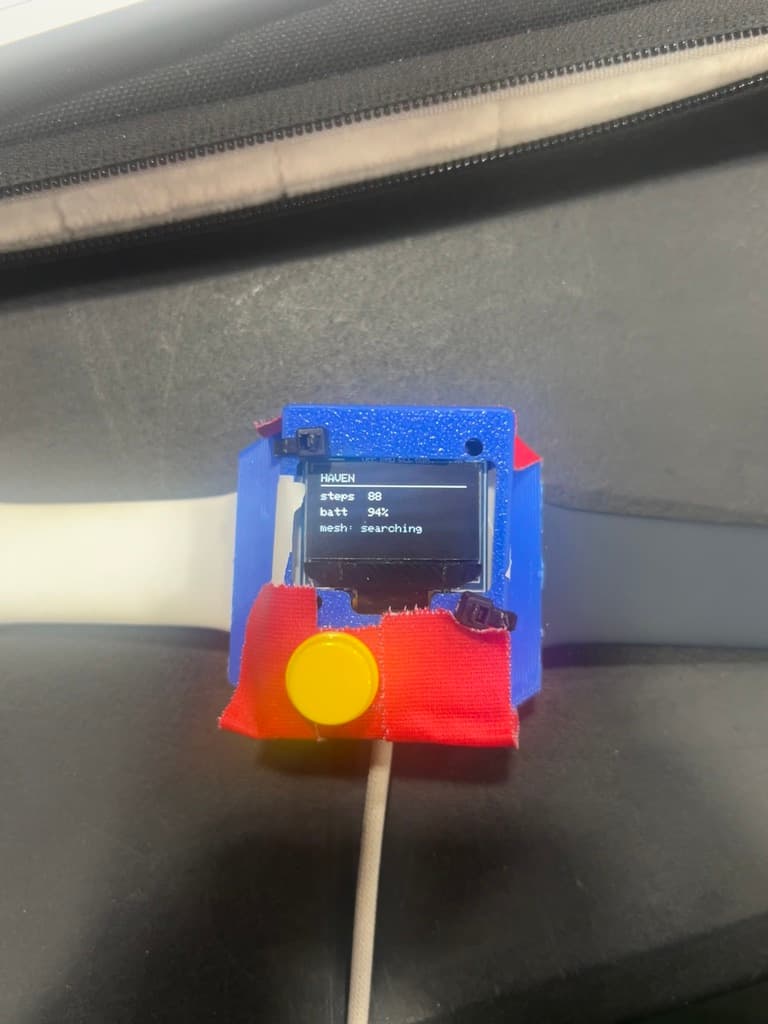
At Milpitas Hacks 2026 I built HAVEN, a watch for people who are unhoused. It shows nearby shelter and resource information with no internet connection, counts steps, watches for a fall, and calls for help when you hold the button.
Why a watch
Most tools for finding a shelter bed or a meal assume you have a smartphone, a data plan, and a charged battery. Many of the people who need that information most do not have all three. A phone is also easy to lose or have stolen.
HAVEN starts from the other end. It runs on an ESP32-C3, a microcontroller board that costs a few dollars. It needs no SIM card and no data plan. The whole thing sits in a 3D-printed case on a fabric strap.
How it works
The watch has a small OLED screen, an accelerometer, an NFC module, and one button. You tap to move between screens and hold to act. The screens cover steps and battery, nearby resources, a food-stamp screen, and SOS.
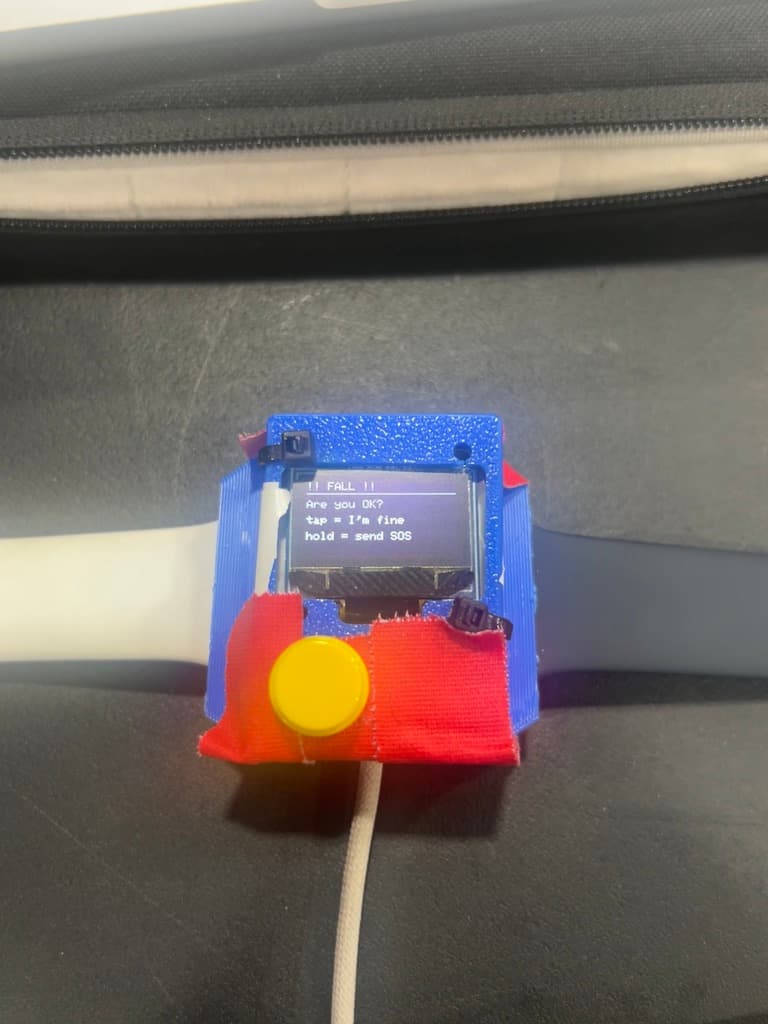
The accelerometer does two jobs. It counts steps, and it watches for a fall. If it sees a sharp drop followed by an impact, a fall screen takes over and gives you ten seconds to tap “I’m fine” before it sends an SOS on its own.
The network is the part I find most interesting. The design is for shelters to run small beacons that broadcast bed and meal counts over ESP-NOW, a radio protocol that needs no WiFi router and no internet. Repeaters pass those messages farther out, so the information spreads from device to device. Every message is signed, so nobody can fake a resource update or a call for help. For the demo, a laptop stood in for the beacon.
The dashboard
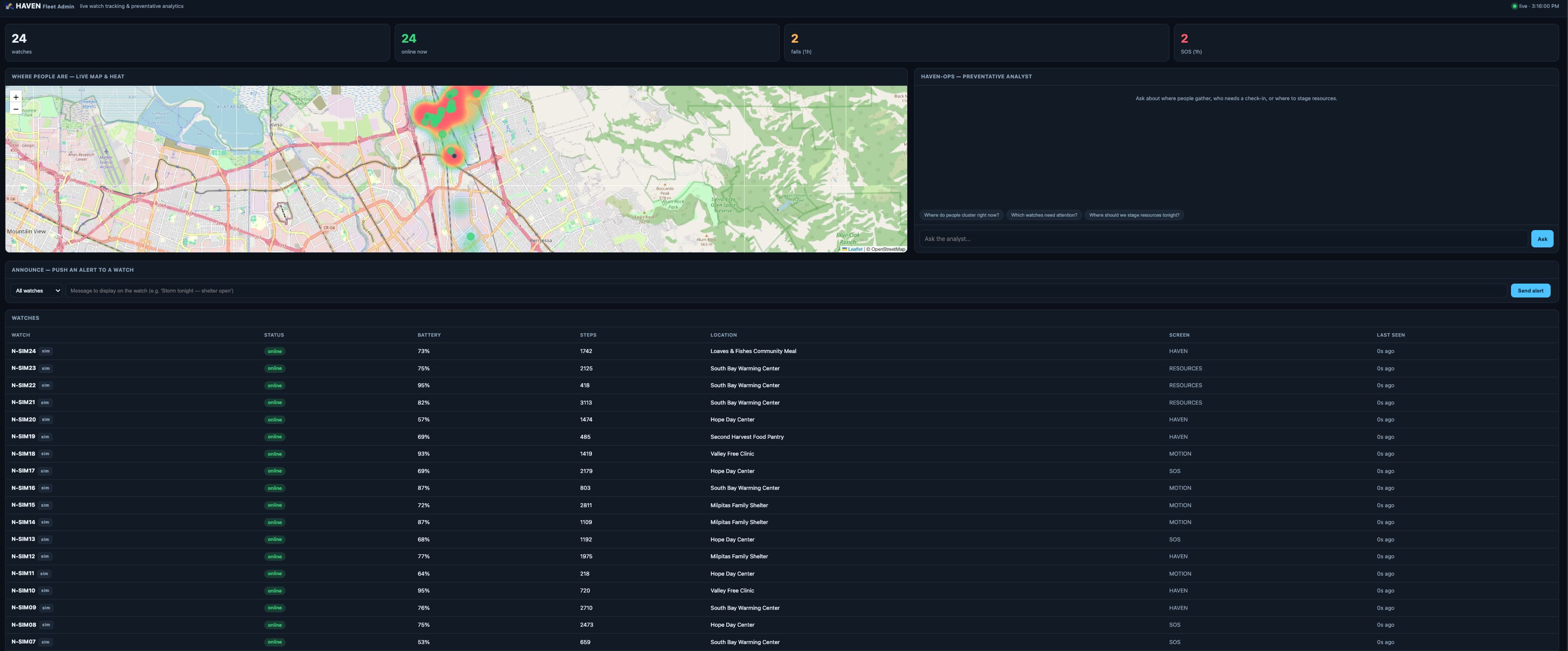
The watches check in with a server, which feeds a dashboard for shelter staff. Every watch is a dot on a live map, and an AI analyst reads the location history to suggest where people are gathering and where to send resources before a cold night.
Why I think this could matter
This is a hackathon prototype, and none of what follows has been tested with real users. In theory, though, the approach changes three things.
Cost. The parts are cheap enough that a shelter or a city could hand these out the way they hand out blankets. Losing one is not a disaster.
Ease. There is nothing to sign up for and nothing to configure. One button, a few screens, and it works without a connection.
Reach and contact. Outreach today depends on staff finding people, or people finding staff. A mesh of cheap devices could carry up-to-date information to people wherever they are, and carry a call for help back. Each added beacon or repeater extends how far that goes.
Building it
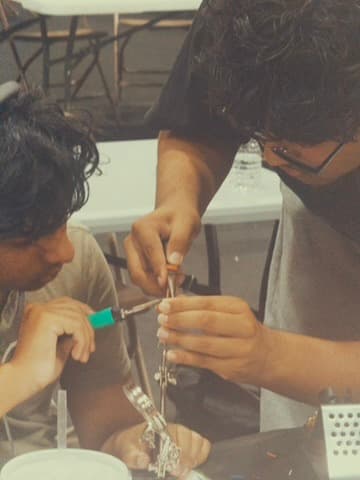
Most of my hackathon projects have been software. This one meant soldering a board under a magnifier and debugging things that software cannot fix, like a loose wire.
The code, wiring, and a simulator that runs without hardware are all in the repository.